RE at Lawley Primary School
Our school vision
The whole school community at Lawley have high expectations for our children, and strive to ensure they leave school as confident, polite and independent young people, with the appropriate skills, values and learning to become successful in whatever their future will be. We aspire to instil in all our children a desire to never stop learning and to have the courage to succeed in whatever they do, across all areas of school life and beyond. At Lawley we are ‘Planting the seeds, growing the future.’
Led by Matthew Burton
Intent
The teaching of RE at Lawley Primary School is based on the principle that children need to learn about religion and from religion. We aim for our pupils to become confident and independent learners who make a positive contribution to society in their future lives. Learning about religion at Lawley aims to inspire pupils to be interested and inquisitive. It includes enquiry into and investigation of the nature of religion, its key beliefs and teachings, practices, their impacts on the lives of believers and communities, and the varying ways in which these are expressed. It includes these 4 areas: engagement, investigation, evaluation and expression. Pupils learn to communicate their knowledge and understanding using specialist vocabulary.
Learning from religion is concerned with developing pupils’ reflection on and response to their own experiences and their learning about religion. It develops pupils’ skills of questioning identity and belonging, meaning, purpose and truth, and values and commitments.
Inclusion and differentiation for children with SEN and EAL are taken into account in our planning and teaching as they are in all areas of the curriculum. Within the teaching of RE we make the most of opportunities to help the children develop their sensitivity to relevant issues, links to British Values and to develop positive attitudes towards themselves and others.
We endeavour to draw on the varied experiences and backgrounds of our pupils and staff in order to make RE relevant and interesting to our pupils. One way of doing this is through our links with local religious communities and places of worship.
Our principle aims for RE are for children to:
- Develop awareness of their own views and feelings and be sensitive to the views and feelings of others.
- Begin to know about their own cultures and beliefs and those of other people.
- Become aware of, and able to express, their feelings of joy, sadness, wonder, awe and mystery.
- Care for themselves and for others.
- Become aware of what it means to trust and to be trusted, to be loved and valued and to feel secure in belonging.
- Learn how to listen, thank, say sorry, express appreciation and rejoice with others.
- Appreciate, enjoy and care for their environment.
- Explore some of the signs and symbols used in religious and everyday life.
- Become aware that certain people, including their wider family, places,
objects and clothing can have special importance.
Recording
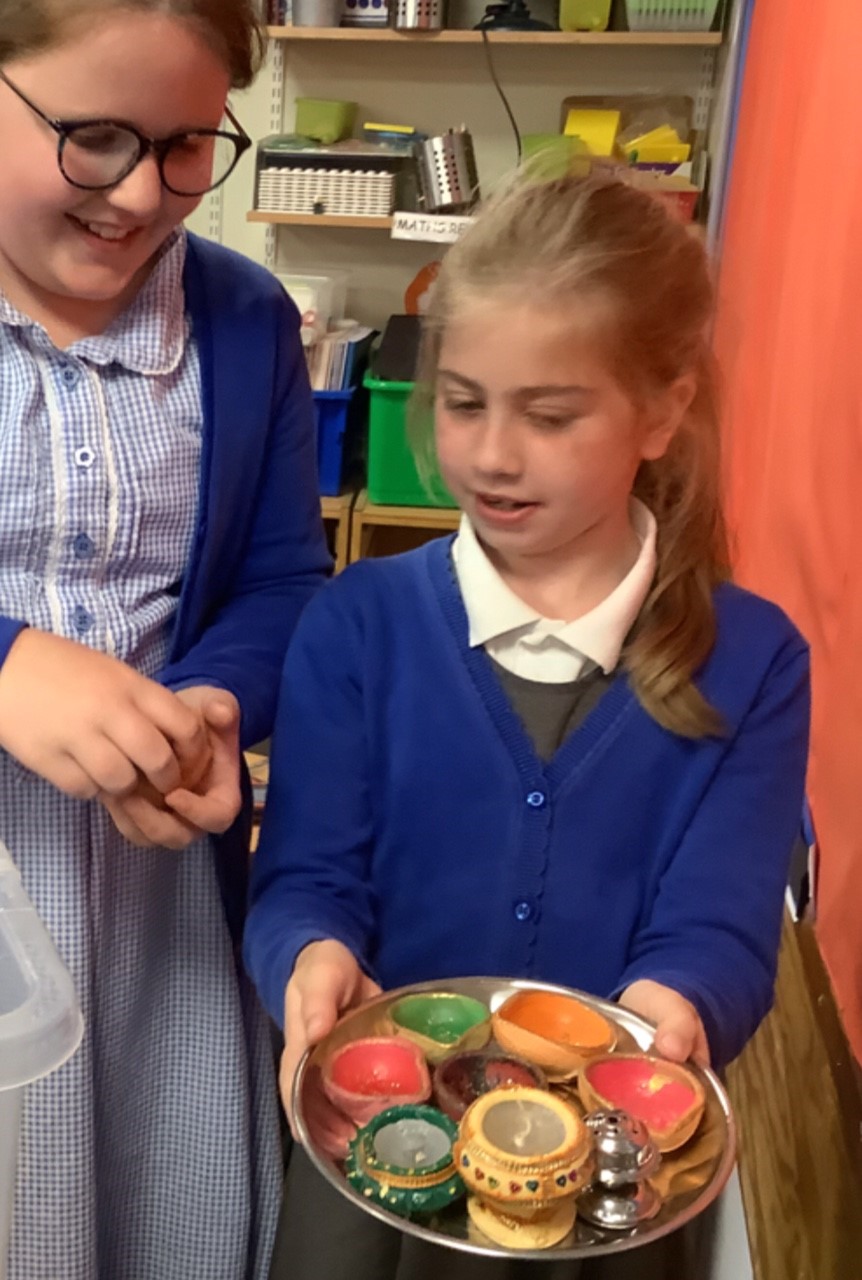
RE provides opportunities for the children to record work in a variety of ways including class discussions, role play and art and craft. Pupils’ written work is recorded in their SMSC books and is marked in accordance with the schools marking policy. All work is collated on our online platform Showbie. At the end of each half term, children’s successes from their RE lessons, will be shared on the RE board with photos of learning, children’s quotes and examples of work present for each year group.
RE and other subjects
Through RE children have the opportunity to develop many key skills such as thinking, researching, evaluating, reflecting and empathising. Wherever possible, links are made between Religious Education and other curriculum subjects through our RE days.
Implementation
At Lawley Primary School, our Religion and Worldviews curriculum encourages pupils to become curious, reflective and open-minded learners. Through exploring a range of religions, beliefs and worldviews, children are supported to ask thoughtful questions, consider different perspectives and reflect on their own values and experiences.
The curriculum helps pupils understand how religion and worldviews shape individuals, communities and cultures, both in the past and today. Through this learning, children develop respect for diversity and gain the knowledge and skills needed to engage positively with others in our multicultural society.
Using the Kapow Primary Religion and Worldviews scheme, lessons are designed to be engaging, inclusive and ambitious for all learners. The curriculum supports children in developing confidence, critical thinking and empathy, while ensuring every pupil can participate fully and achieve their potential.
Impact
Impact
Assessment in RE is designed to ensure that teachers understand how well pupils are developing their geographical knowledge, vocabulary and enquiry skills. Our approach is continuous, discussion-rich, balanced and reflective. It is based on the knowledge and skills on our progression map.
- Each lesson begins with a relevant 'Connect' activity allowing teachers to assess pupils' understanding and knowledge from previous lessons and skills. Teachers are then able to identify misconceptions early and ensure all pupils are ready to move confidently into new learning.
- Throughout the lessons, we continually assess the children through verbal feedback, targeted questioning, discussion and observing their ability to complete tasks.
- Each lesson ends with a structured plenary. Pupils discuss key questions taken from the Kapow 'wrapping up' section, they share their ideas and reasoning and they may complete a short activity to demonstrate their understanding of the lesson's learning. From this, teachers know what has been understood and are able to respond by adjusting planning and addressing misconceptions.
- At the end of each unit, pupils complete a short quiz to check their recall of key knowledge and they also complete an assessment as learning task. These vary in form but are all taken from the Kapow knowledge and skills catcher assessment resources and are designed to help pupils reflect on their learning and give teachers a clear picture of progress across the unit.
If you wish to withdraw your child from all or part of RE please contact the school office.